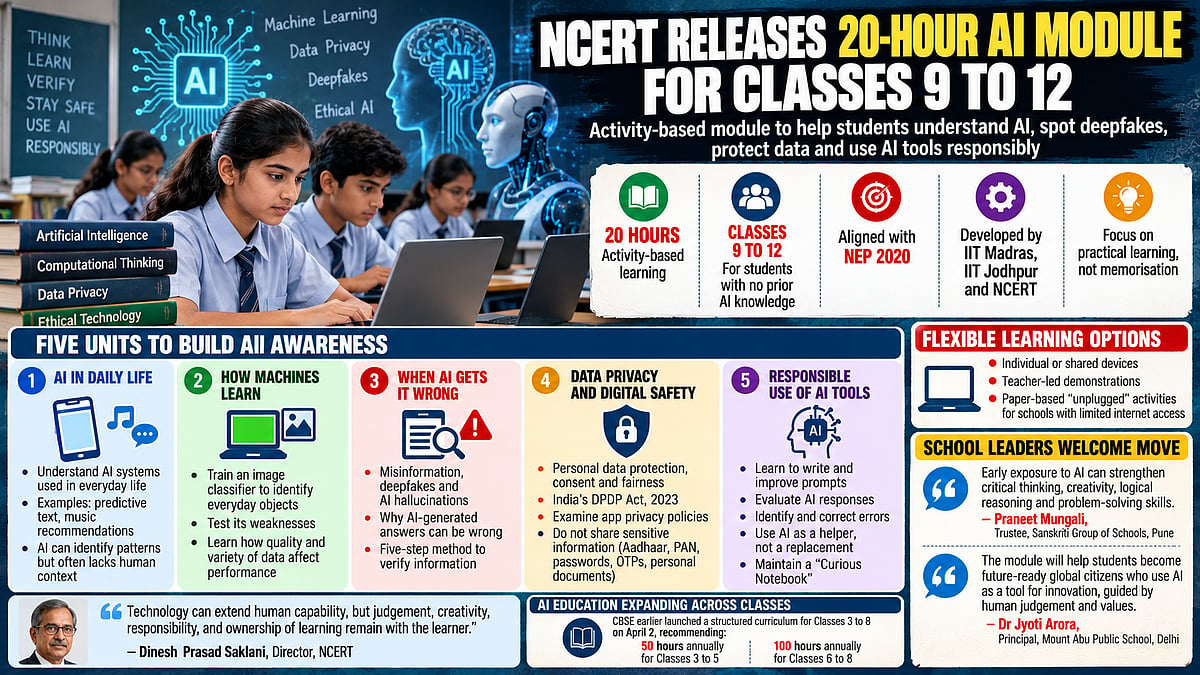
A New Chapter for AI Literacy
Artificial intelligence is no longer a futuristic concept relegated to computer science labs; it is a foundational technology reshaping how students learn and interact with the world. To ensure the next generation is equipped to navigate this landscape, the National Council of Educational Research and Training (NCERT) has officially introduced a 20-hour module on AI and computational thinking for students in classes 9 to 12.
Developed in collaboration with experts from IIT Madras and IIT Jodhpur, the curriculum aligns with the National Education Policy (NEP) 2020. The goal is to move beyond teaching students how to use AI tools, pushing them instead toward a deeper understanding of how these systems function, their inherent limitations, and the ethical responsibilities that come with their use.
What the Curriculum Covers
The module is divided into five core units designed to build both technical knowledge and critical thinking skills. It emphasizes an activity-based approach, ensuring that students can grasp concepts even in environments with limited computer or internet access. Key areas of focus include:
- Machine Learning foundations: Understanding the basic mechanisms behind AI models.
- Digital Safety and Privacy: Navigating data security in an age of constant connectivity.
- Deepfake Detection: Identifying manipulated media and understanding the implications of synthetic content.
- AI Hallucinations: Recognizing when and why AI tools provide incorrect or misleading information.
- Effective Prompting: Learning the art of interacting with AI systems to achieve accurate results.

Why This Strategy Matters
As AI tools continue to proliferate in educational settings, many experts argue that simple access is insufficient. According to research on AI integration, schools that fail to provide a structured strategy for AI literacy risk disruptions in learning and data security concerns. By introducing a standardized curriculum, NCERT is attempting to transition schools from reactive users of AI to proactive, critical thinkers.
Learning AI will not just mean learning to use tools. NCERT wants students in classes 9 to 12 to understand the technology and its limits.
— NCERT Educational Framework
The focus on ethics and critical evaluation is particularly timely. With students increasingly reliant on AI for academic tasks, the ability to discern fact from machine-generated fiction is now as important as traditional literacy skills. By framing AI as a supplement rather than a replacement for human intellect, the initiative seeks to foster a generation that treats AI as a 'friend'—a tool that enhances creativity and logic while acknowledging its inherent risks.