technology••5 min read

The AI Hardware War: How AMD is Challenging Nvidia’s Computing Monopoly

The race for AI dominance has moved beyond simple GPU speed to a full-stack infrastructure battle. AMD is now aggressively positioning itself to disrupt Nvidia’s long-standing grip on the data center market.

The AI Hardware War: How AMD is Challenging Nvidia’s Computing Monopoly

Beyond the GPU: The New Era of AI Computing

For years, Nvidia has been the undisputed king of artificial intelligence hardware. However, as of 2026, the playing field is shifting. The AI wars have evolved from a focus on raw GPU performance to a comprehensive battle for the entire computing stack. This includes AI accelerators, memory, networking, CPUs, and the software layers that tie it all together.

Under the leadership of CEO Lisa Su, AMD is no longer just a secondary player. The company is actively building a vertically integrated ecosystem designed to give data center operators a viable alternative to Nvidia’s CUDA-dominated landscape.
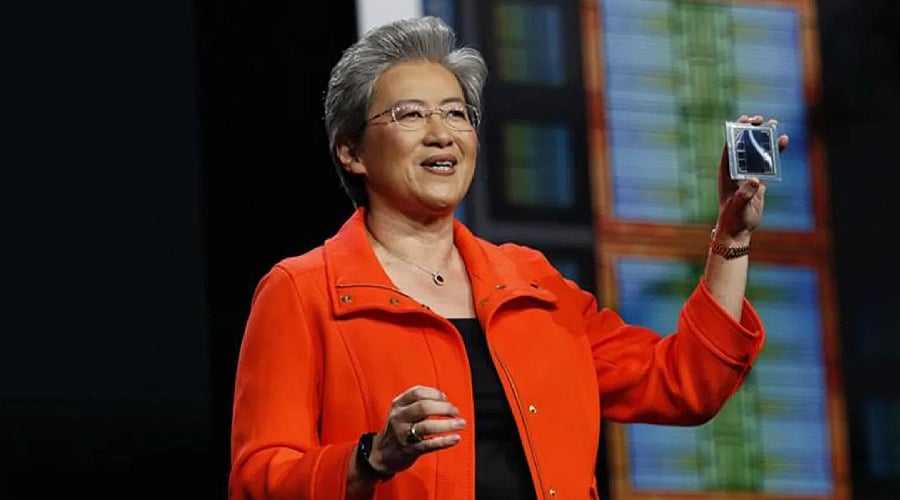
AMD CEO Lisa Su is leading an aggressive strategy to capture a larger share of the AI data center market.

AMD’s Strategy: Full-Stack Integration

AMD’s path to challenging Nvidia rests on its ability to offer a cohesive, high-performance computing environment. By leveraging its Instinct GPU series alongside its specialized CPU architectures, AMD is aiming to provide the rack-scale systems that modern hyperscalers demand.

  • ROCm Software: AMD’s open-source compute platform serves as the critical alternative to Nvidia’s proprietary CUDA software stack.
  • Instinct Accelerators: High-performance GPUs engineered specifically for large-scale AI training and inference workloads.
  • System-Level Synergy: Deep integration of CPU and GPU technologies designed to maximize throughput in high-performance computing (HPC) environments.
  • Strategic Pricing: AMD is utilizing competitive pricing models to lower the barrier for large-scale data center deployment.

The competition in 2026 is no longer simply about which company makes the fastest GPU. It is about who can provide the most stable, efficient, and scalable infrastructure for the next generation of AI.

— Industry Analysis

The Future: A Hybrid AI Ecosystem

While Nvidia retains its lead in high-end AI training, the market is moving toward a hybrid ecosystem. Hyperscalers and data center operators are increasingly seeking diversity in their supply chains to avoid vendor lock-in. As hardware becomes more complex—incorporating advanced components like HBM4 memory—the ability for AMD to prove the stability and efficiency of its ROCm platform will be the deciding factor in its long-term success.

Key Takeaways

  • The AI chip market has shifted from raw GPU performance to a full-stack infrastructure battle.
  • AMD is positioning its Instinct GPU series and ROCm software as the primary alternatives to Nvidia's ecosystem.
  • Data center operators are increasingly seeking supply chain diversity, fueling demand for AMD hardware.
  • Successful AI hardware now requires integration across CPUs, networking, memory, and specialized software.
  • Nvidia continues to lead in training, but AMD is making significant strides in AI accelerator adoption.

FAQ

What is AMD's main alternative to Nvidia's CUDA?

AMD’s primary alternative to Nvidia's CUDA is the ROCm (Radeon Open Compute) platform, which is designed as an open-source alternative for AI and high-performance computing.

Why are companies looking for alternatives to Nvidia?

Many data center operators are seeking alternatives to avoid vendor lock-in and to achieve a more diverse supply chain in a rapidly growing AI hardware market.

Does AMD only make GPUs for AI?

No, AMD provides a full-stack approach including high-performance EPYC CPUs, specialized Instinct AI accelerators, and networking technology to create complete rack-scale AI systems.

Is Nvidia still the leader in AI hardware?

Yes, Nvidia remains the leader, particularly in high-end AI training and inference, though AMD and custom ASIC providers are steadily gaining ground in specific market segments.

Related Videos

Nvidia vs AMD: Who Will be the King of AI chips?

The Motley Fool

AMD vs. Nvidia: Ben Bajarin and Matt Bryson on the AI Chip Battle

Schwab Network

How Nvidia GPUs Compare To Google’s And Amazon’s AI Chips

CNBC

Sources