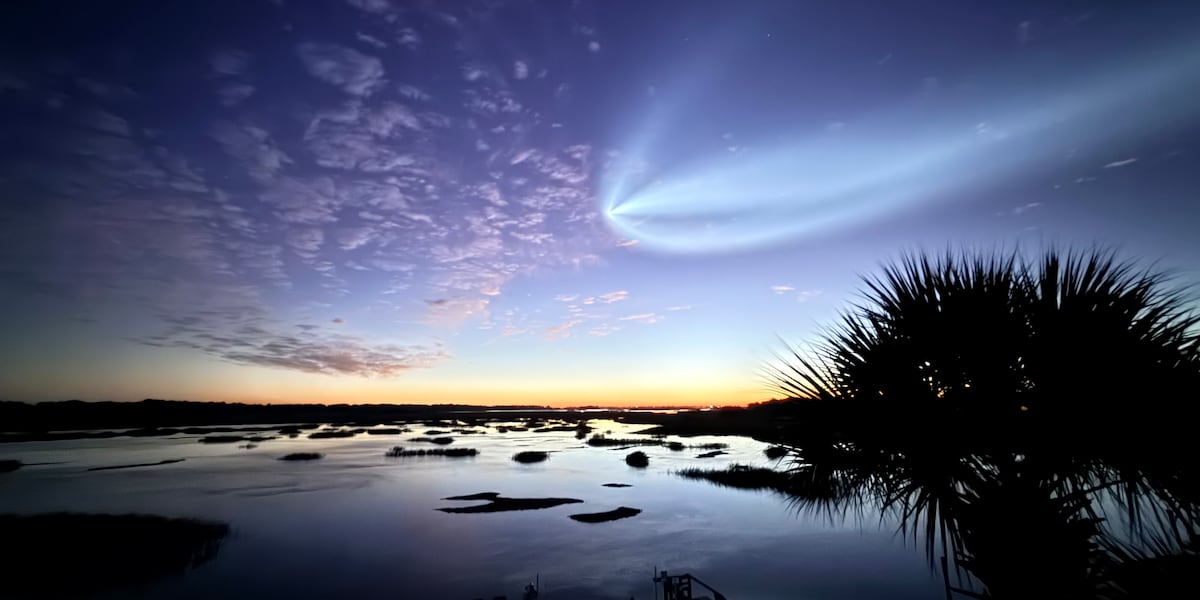
A Spectacular Sight Over the Lowcountry
Residents across the Lowcountry and beyond were treated to a rare celestial light show early Tuesday morning. A SpaceX Falcon 9 rocket, carrying a Dragon cargo spacecraft bound for the International Space Station (ISS), launched from Cape Canaveral, leaving a glowing, ethereal trail in the pre-dawn sky.
The mission, which included essential solar arrays and scientific research experiments, served as more than just a logistical delivery. For students from the University of Colorado Colorado Springs and Pikes Peak State College, the launch was a monumental occasion—some traveled to Florida to watch their own experiment ascend into orbit.

Understanding the 'Jellyfish Effect'
Observers often describe the phenomenon as a 'space jellyfish' due to the bulbous, glowing plume of exhaust trailing the rocket. This visual display is scientifically known as the twilight phenomenon.
- The phenomenon requires a twilight launch: when the ground is dark, but the rocket is high enough to catch sunlight.
- As the rocket climbs, the exhaust plume expands in the thin upper atmosphere, creating a large, glowing shape.
- The plume reflects sunlight at high altitudes, making it visible against the dark backdrop of the early-morning or late-evening sky.
While the sight can look alien to the untrained eye, it is a perfectly normal reaction between rocket exhaust and high-altitude sunlight. The curvature of the Earth plays a vital role, allowing the rocket to emerge into direct sunlight while those on the ground remain in darkness.
A Vital Mission for Space Science
Beyond the aesthetic appeal, the mission represents a critical step for station operations. The Dragon spacecraft is loaded with hardware to maintain the station's power systems and a host of experiments from academic institutions. By conducting these missions regularly, SpaceX ensures that the orbiting laboratory remains equipped to push the boundaries of human knowledge.
If you’re looking to experience this phenomenon firsthand, be sure to check the space launch schedule for twilight and pre-dawn launches. With the right conditions and a bit of luck, you could witness one of the most beautiful sights in the world of space exploration.
— Space Launch Schedule