
Taking Control of Your AI Workflow
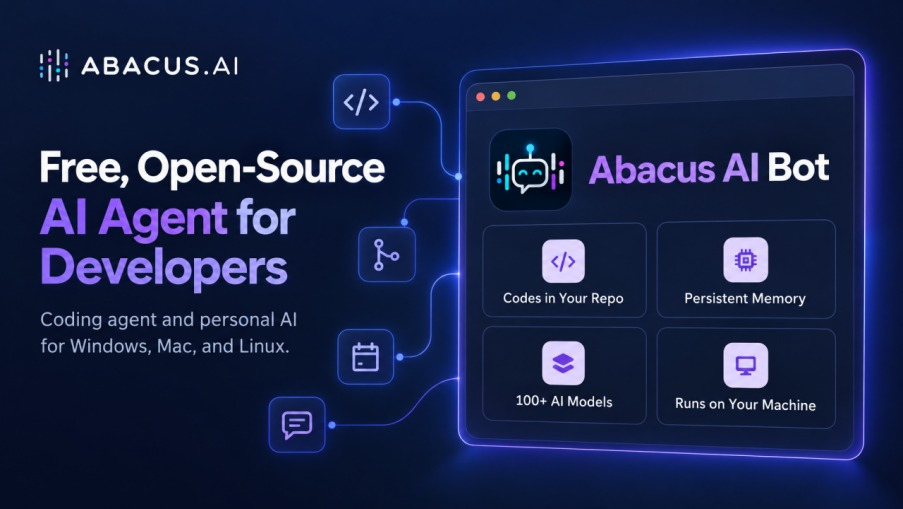
For most of us, interacting with AI means jumping between different browser tabs and paying monthly subscription fees for isolated chat windows. Abacus AI is looking to disrupt that model with the release of its new Abacus AI Bot. This open-source tool is designed to bring your AI interactions, research, and communication workflows into a single, unified client-side application.
What sets this apart from typical browser-based AI is its architecture: it runs directly on your computer—whether you're on Windows, Mac, or Linux. Because it lives on your own machine, it bridges the gap between your local files and your favorite online services, offering a level of connectivity that standard chat interfaces simply cannot match.
Automation Beyond the Chat Window
Abacus AI Bot isn't just for querying an LLM; it is built to perform actual work. The platform features persistent memory, meaning it remembers your preferences, instructions, and past conversations across different sessions. You can configure it to handle recurring tasks automatically, such as:
- Morning Briefs: Aggregating unread emails, Slack messages, and upcoming calendar events.
- Research Scout: Conducting live internet research on industry trends.
- Bug Triage: Analyzing incoming software reports to draft potential resolutions.
- Cross-Platform Integration: Connecting with tools like Slack, Jira, Notion, GitHub, and Figma.
The tool supports a massive range of third-party integrations via OAuth, ensuring that while the bot works on your behalf, you maintain control over which services it can access. Furthermore, for users who prefer their own models, the bot allows you to plug in your own API keys, providing a path forward once the initial 2,000 complimentary credits are exhausted.
Abacus AI Bot was designed around a simple idea: users shouldn't face paywalls to access capable automation partners.
— Abacus AI
Prioritizing Privacy and Local Control
In an era where data privacy is a primary concern for developers and professionals, Abacus AI has implemented a strict data policy. User-specific API keys and credentials are stored locally on your device and never leave your machine. While the service relies on Abacus.AI’s servers to function, the company maintains that user data is private and, crucially, is not used to train their AI models.
Because the agent runs locally, it requires your computer to stay powered on and connected to the internet to complete background tasks. It is a trade-off for having a highly customizable, persistent assistant that works while you are away from your desk, effectively turning your local hardware into an automated command center.