space exploration••5 min read

NASA Just Launched the Roman Space Telescope to Decode the Universe's Darkest Mysteries

NASA's Nancy Grace Roman Space Telescope has successfully launched, marking a new milestone in space exploration. The observatory will spend its mission mapping dark energy and dark matter across the cosmos. It represents a significant leap in our ability to survey billions of galaxies.

NASA Just Launched the Roman Space Telescope to Decode the Universe's Darkest Mysteries

A New Eye on the Cosmos

On August 30, 2026, the scientific community watched as NASA’s Nancy Grace Roman Space Telescope lifted off from Kennedy Space Center. Carried by a SpaceX Falcon Heavy, the observatory is currently embarking on a 1.5 million kilometer journey to the second Sun-Earth Lagrange point (L2). This mission is not just another telescope; it is a specialized instrument designed to peer into the most elusive aspects of our universe.
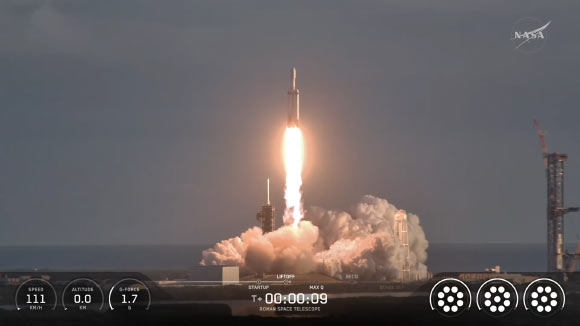
The Roman Space Telescope launching aboard a SpaceX Falcon Heavy.

Probing Dark Energy and Dark Matter

The primary objective of the Roman Space Telescope is to solve some of the most profound mysteries in astrophysics. By surveying billions of galaxies and monitoring supernovae, the telescope aims to map the influence of dark matter and dark energy. These phenomena make up the vast majority of our universe, yet they remain largely hidden from traditional observation methods.

  • Mapping the distribution of dark matter across cosmic time.
  • Investigating the expansion of the universe driven by dark energy.
  • Surveying billions of galaxies to provide an unprecedented wide-field view.
  • Searching for exoplanets and studying planetary science beyond our solar system.

Technical Precision and Future-Proofing

Equipped with the Wide Field Instrument (WFI) and a sophisticated Coronagraph, the Roman Space Telescope is built for discovery. Beyond its primary scientific goals, the mission is designed with longevity in mind. The observatory features an architecture that allows for potential robotic refueling, which could significantly extend its operational life well beyond its initial mission parameters.

The Roman mission represents a new frontier in astrophysics, utilizing private-sector launch capabilities to push the boundaries of how we observe the hidden mechanics of our universe.

— NASA Mission Overview

Key Takeaways

  • The Roman Space Telescope launched successfully on August 30, 2026, via a SpaceX Falcon Heavy.
  • Its primary mission is to map dark matter and dark energy on a cosmic scale.
  • The telescope will travel 1.5 million km to reach its operational post at the Sun-Earth L2 point.
  • It utilizes both a Wide Field Instrument and a Coronagraph for deep-space surveying.
  • The mission is designed with robotic refueling capabilities to potentially extend its lifespan.

FAQ

What is the primary goal of the Roman Space Telescope?

Its main goal is to map dark matter and dark energy by surveying billions of galaxies and observing supernovae.

Where is the telescope headed?

It is traveling to the second Sun-Earth Lagrange point (L2), which is approximately 1.5 million kilometers from Earth.

Who launched the telescope?

NASA utilized a SpaceX Falcon Heavy rocket for the launch under a $255 million contract.

Can the Roman Space Telescope be refueled?

Yes, it is designed with the capability to be grappled and refueled robotically in space to extend its mission duration.

Related Videos

Nancy Grace Roman Space Telescope Launch

NASA

Nancy Grace Roman Space Telescope Prelaunch News Conference

NASA

Everything You Need To Know About NASA's Roman Space Telescope

NASA Goddard

Sources