A New Chapter for Legal AI
The race for the most capable Large Language Model (LLM) just gained a specialized contender. Thomson Reuters has officially unveiled Thomson 1.0, a proprietary, open-weights AI model built on the company’s massive repository of legal, tax, and accounting content. Unlike the general-purpose models from giants like OpenAI, Anthropic, or Google, Thomson 1.0 is engineered from the ground up for the professional, high-stakes requirements of the legal industry.

The Power of Proprietary Data
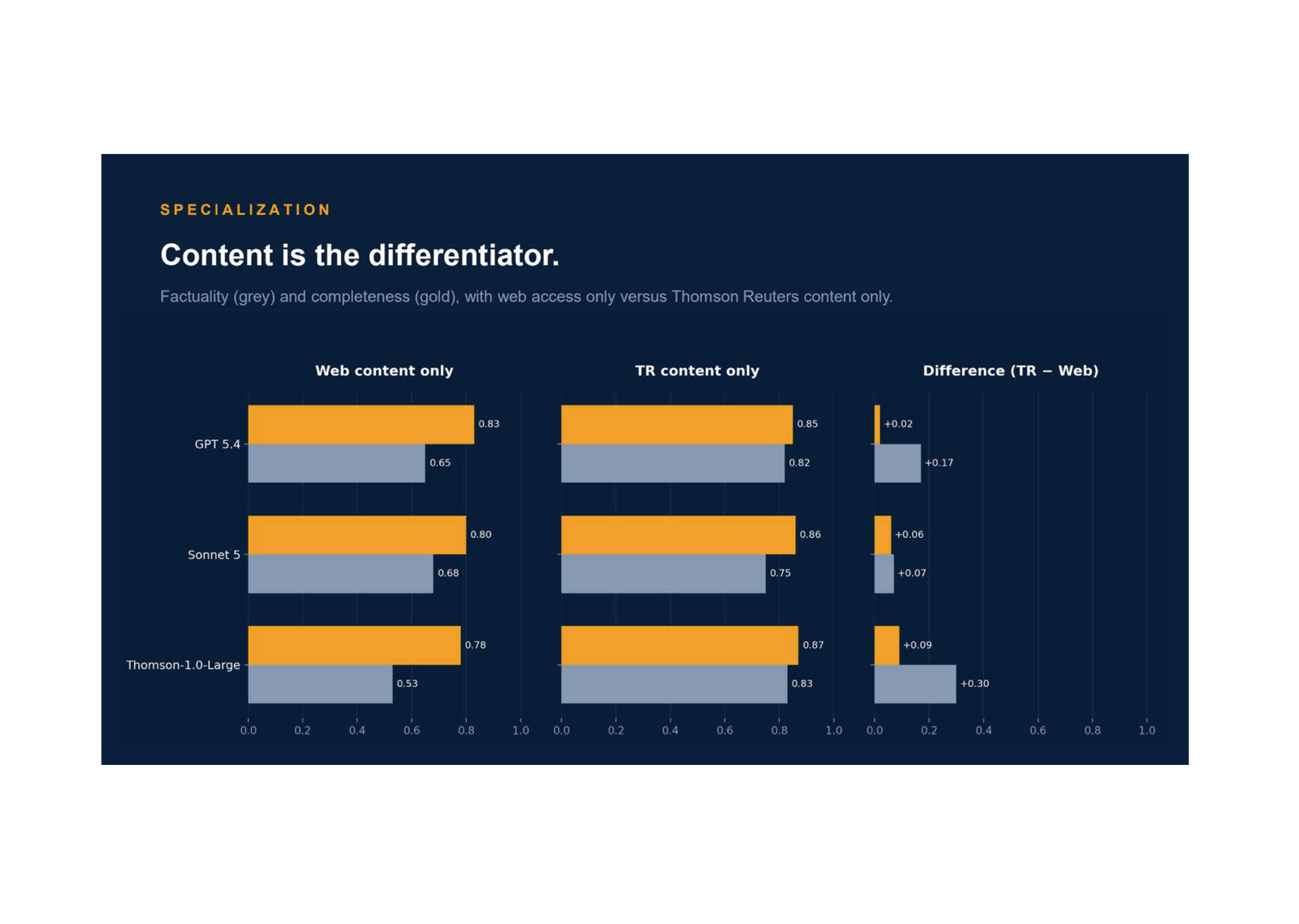
Thomson 1.0 distinguishes itself by leaning heavily on trusted, curated data. The model was trained using content from Westlaw, Practical Law, and Checkpoint. By focusing on this proprietary information, Thomson Reuters claims that the model achieves superior performance in specific domain tasks compared to larger, more generalized models. Notably, the model was developed at a fraction of the compute costs associated with current frontier models, having been trained on less than 10% of the company's total available content to date.
- Purpose-built for legal, tax, and accounting workflows.
- Outperforms general-purpose LLMs when leveraging TR-specific data.
- Launched as an open-weights model to allow for community evaluation and validation.
- First major integration slated for CoCounsel Legal’s Tabular Analysis feature.
Strategic Deployment in CoCounsel
The first public test for Thomson 1.0 is a deliberate one: integration into the Tabular Analysis feature within CoCounsel Legal. This feature requires high-volume, structured document review where accuracy is paramount. By deploying the model in a setting with clear, measurable standards, the company intends to demonstrate the immediate practical advantage of a model trained on domain-specific expertise versus a generalist alternative.
TR sees the open-weight release as a mechanism for really anybody in the world to pick it up and critique and validate or invalidate any aspects of what we’re saying.
— Representative from Thomson Reuters